ZeroGPT Review: A Comprehensive Evaluation of the Popular AI Content Detector in 2026
In an era where AI-generated text from models like ChatGPT, GPT-5, Gemini, and Claude floods the internet, distinguishing human-written content from machine-produced material has become essential for educators, publishers, content creators, and students alike. ZeroGPT, accessible at zerogpt.com, has positioned itself as one of the most accessible and widely used AI detectors since its rise in popularity. Marketed as "the most advanced and reliable ChatGPT, GPT-5 & AI Content Detector," it promises high-accuracy identification of AI-written text while offering a suite of supporting tools.
This review evaluates ZeroGPT based on its core detection principle, full feature set, real-world accuracy performance (drawing from 2025–2026 independent tests), and comparisons with leading alternatives like GPTZero and Turnitin. With millions of users trusting it for quick checks, is ZeroGPT the gold standard, or does it fall short in critical scenarios? Let's dive in.
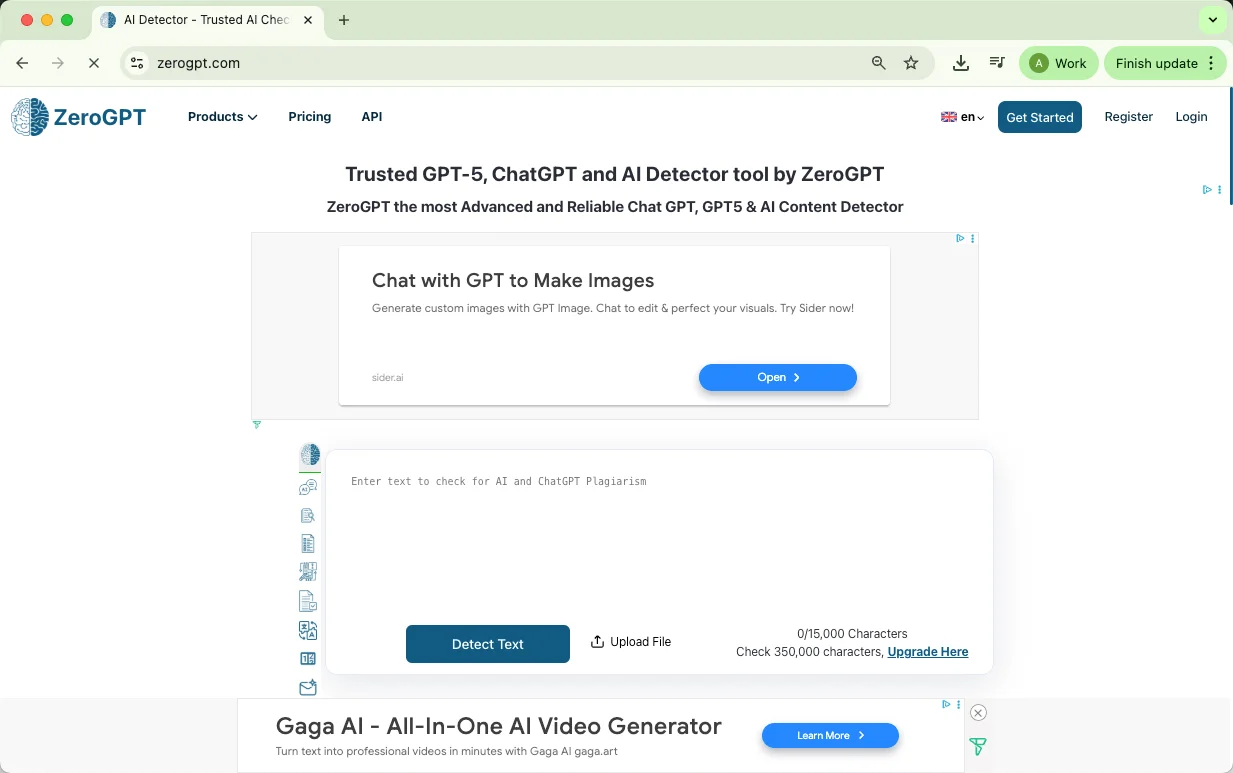
1. ZeroGPT's Principle for Identifying AI-Generated Content
At the heart of ZeroGPT lies its proprietary DeepAnalyse™ Technology, a multi-stage deep learning system designed specifically for AI content detection. Unlike basic rule-based checkers that rely on simple keyword matching, DeepAnalyse™ scans text at both macro and micro levels. It analyzes linguistic patterns, sentence structure, vocabulary predictability, and overall coherence to determine whether content originates from a human or an LLM (large language model).
The model is trained on an enormous dataset comprising real human-written texts from the internet and educational sources, combined with proprietary synthetic datasets generated by various LLMs such as GPT series, Claude, Gemini, and others. This training enables it to recognize subtle "fingerprints" of AI writing — for instance, overly uniform sentence rhythms, repetitive phrasing patterns, or unnaturally consistent burstiness (the variation in sentence length and complexity that humans naturally exhibit but AIs often smooth out).
The process works in stages: initial probabilistic classification flags potential AI traits, followed by deeper forensic analysis that cross-references against known human vs. machine distributions. This approach minimizes both false positives (flagging human text as AI) and false negatives (missing AI text). ZeroGPT explicitly supports detection across major models including ChatGPT, GPT-4/5, Gemini, Grok, Perplexity AI, Claude, DeepSeek, and LLaMa. Importantly, the technology evolves continuously through algorithmic updates to counter new LLM advancements, ensuring relevance in 2026. While the exact neural architecture remains proprietary, the emphasis on ensemble modeling and adversarial training aligns with industry best practices for reducing bias and improving robustness. This makes ZeroGPT more than a simple "perplexity calculator" (a metric used by some competitors to measure text predictability) — it's a holistic, multi-layered AI classifier.
In practice, users paste text or upload files, and the tool outputs a percentage score (e.g., "98% AI-generated") along with highlighted sentences and a detailed gauge. This transparency in breakdown helps users understand why content was flagged, going beyond black-box results.
2. Full Feature Introduction: More Than Just Detection
ZeroGPT has evolved from a basic AI checker into a comprehensive writing toolkit, making it appealing for everyday users who need more than detection alone. The core AI/GPT Detector remains the flagship, supporting up to 350,000 characters in the free tier (with premium unlocking higher limits and batch processing). It provides instant results, sentence-level highlighting, and downloadable PDF reports as proof of authenticity — ideal for students submitting assignments or writers verifying client content.
Beyond detection, the platform integrates several AI-powered utilities:
- AI Humanizer: Transforms AI-generated text into more natural, human-like prose while preserving meaning — useful for creators aiming to bypass other detectors ethically.
- AI Image Detector: A newer addition that analyzes visuals to determine if they were created by tools like DALL·E or Midjourney.
- Plagiarism Checker: Scans against billions of web sources for duplicate content.
- AI Paraphraser, Summarizer, Translator, and Grammar Checker: These refine, condense, translate (across all languages), and polish text with high accuracy.
- Additional Tools: Word Counter (with keyword density and reading time estimates), Dictionary, Citation Generator, and AI Email Helper for professional correspondence.
A standout is ZeroCHAT, a human-like AI companion available via WhatsApp and Telegram for on-the-go detection, summarization, or paraphrasing. For developers and enterprises, the API integrates these functions into custom apps, with batch file uploads and automated reporting in premium plans.
Pricing is tiered: the free version covers basic needs (up to 15,000 characters per check displayed), while MAX/EXPERT subscriptions unlock unlimited access, PDF exports, and priority support. This freemium model lowers the barrier for casual users while monetizing power users. Multilingual support across all languages with claimed high accuracy further broadens its appeal for global audiences. Limitations include character caps in free mode and occasional ads, but the dashboard remains intuitive and mobile-friendly.
Overall, these features transform ZeroGPT from a one-trick detector into a full content workflow platform, setting it apart from pure detection-focused rivals.
3. Detection Accuracy: Claims vs. Real-World Performance
ZeroGPT boldly claims "high accuracy" through its DeepAnalyse™ model, often citing training on over 10 million texts and rates exceeding 98% in controlled conditions. The official site emphasizes "the highest accuracy rate of detection" across languages and LLMs, with premium models delivering superior results. Some early ZDNet evaluations in 2025 reported perfect 100% accuracy on test sets after the tool matured from earlier versions.
However, 2025–2026 independent reviews paint a more nuanced picture. In practical testing by NoteGPT, real-world accuracy hovered around 80% for mixed content like blogs and articles, with a 25% false-positive rate on human-written text (rising to 58% when including "partly AI" flags). Heavily edited or academic pieces proved challenging, where the tool sometimes flagged polished human writing as 100% AI. Another 2026 test on Skyline Academic echoed this, noting inconsistent results on formal essays — even fully human narratives scored as fully AI-generated in some cases. False positives appear higher than competitors in head-to-heads (15–20% in some studies), particularly for non-native English speakers or short texts under 300 words. Strengths shine with obvious AI content: pure GPT-4/5 outputs are reliably caught at near-100%. Weaknesses emerge with hybrid human-AI text or paraphrased material, where detection drops.
Compared to benchmarks like RAID (a third-party dataset), ZeroGPT performs adequately for casual use but lags behind leaders in low false-positive scenarios. Factors influencing accuracy include text length (longer is better), language complexity, and recent LLM updates — ZeroGPT mitigates this via frequent model refreshes.
Users in education or publishing should treat results as probabilistic guidance rather than definitive proof. Combining ZeroGPT with manual review or multiple tools yields the best outcomes. In summary, it delivers solid 85–95% reliability for everyday checks but isn't infallible for high-stakes academic or legal contexts.
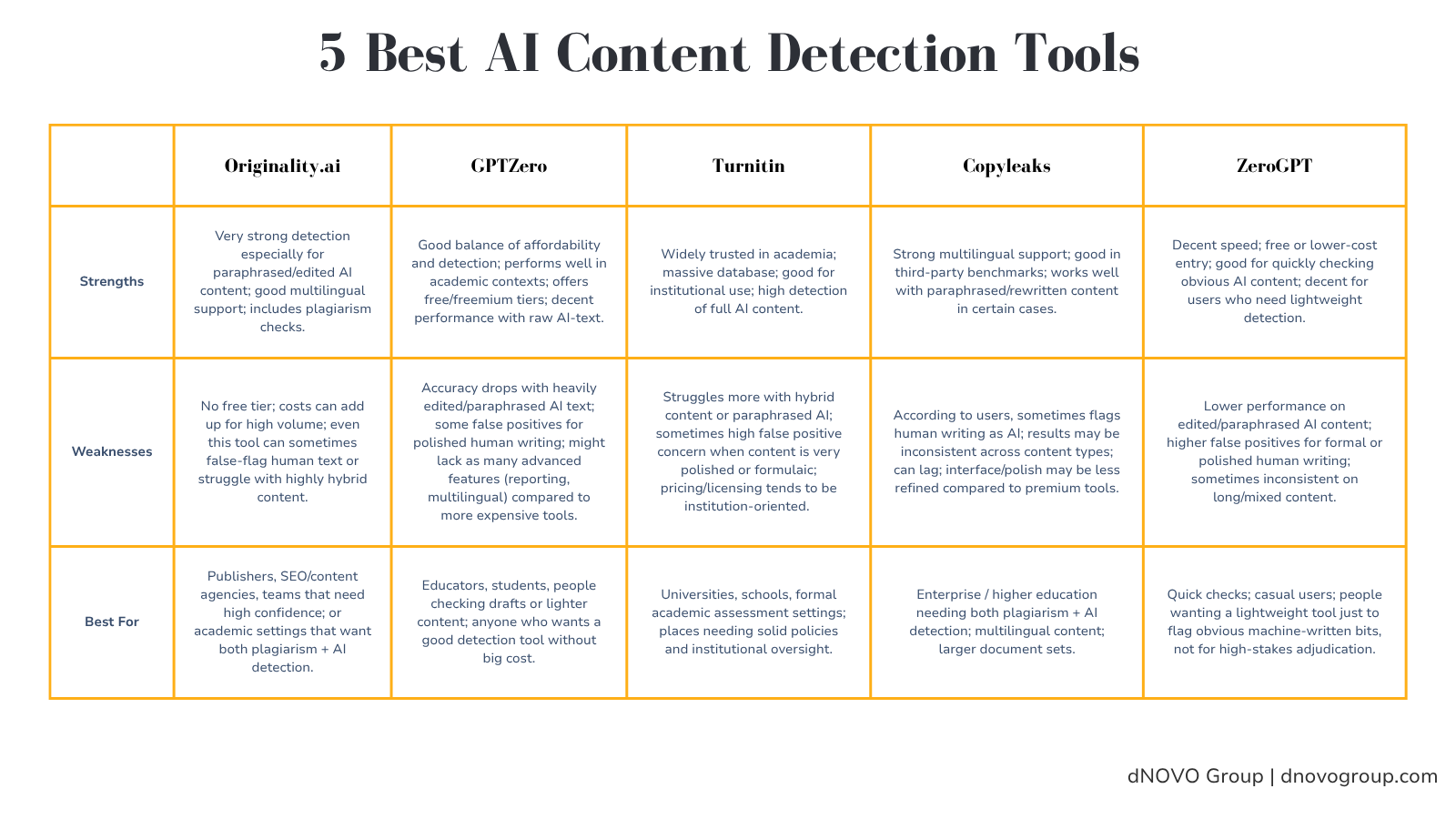
4. Alternatives to ZeroGPT: Turnitin, GPTZero, and Beyond
While ZeroGPT excels in accessibility and extra tools, several alternatives offer specialized strengths. GPTZero consistently ranks as the accuracy leader in 2026 benchmarks, achieving ~99% detection rates with extremely low false positives (around 1–2%, or 0.24% in some tests). It shines in education with sentence-level highlighting, plagiarism integration, and browser extensions. Free tier allows 10,000 words/month; premium starts at $12.99. GPTZero performs exceptionally on hybrid and paraphrased content, making it preferable for teachers and students over ZeroGPT's occasional over-flagging. Independent comparisons (e.g., Chicago Booth and RAID benchmarks) frequently crown it the top performer.
Turnitin, the institutional heavyweight, integrates directly with learning management systems (LMS) like Canvas or Blackboard. Its AI detector boasts 98% accuracy with under 1% false positives for texts over 300 words, backed by massive pre-ChatGPT human writing datasets. No significant bias against English-language learners. However, it's not available to individuals — pricing is institutional only. Turnitin excels in academic integrity workflows but lacks ZeroGPT's free access or extra paraphrasing tools.
Other notable options include Copyleaks (99%+ accuracy, strong multilingual support, enterprise-focused) and Winston AI (99.98% claimed, excellent for publishers). For budget users, Originality.ai offers robust plagiarism + AI checks but at per-credit pricing.
In head-to-heads, GPTZero edges out ZeroGPT for precision and transparency, while Turnitin dominates formal education. ZeroGPT wins for casual, free, all-in-one use cases. Choose based on needs: ZeroGPT for quick personal checks, GPTZero for detailed educator reports, and Turnitin for school-wide enforcement.
Conclusion: Is ZeroGPT Worth It in 2026?
ZeroGPT remains a strong, user-friendly contender in the crowded AI detection space. Its DeepAnalyse™ principle, expansive feature toolkit, and generous free tier make it ideal for bloggers, freelancers, and casual verifiers. Accuracy is reliable enough for most scenarios (especially obvious AI text), though independent tests highlight limitations in hybrid or academic content compared to GPTZero or Turnitin.
For high-stakes applications, supplement with human judgment or cross-check tools. As LLMs evolve, no detector is perfect — but ZeroGPT's ongoing updates and multimodal expansions (like image detection) position it well for the future. If you're seeking an affordable, versatile starting point, it's highly recommended. For ultimate precision, explore GPTZero or institutional options like Turnitin.
If you want to try our AI Text Detector, please access link: https://turnitin.app/